

by David Bradley, EVP Solutions
Even though Goodyear Manager Phil Ensor is credited with coining the phrase “Business Silos” in the late 1980s, the reality is that these towers of business process, information, reporting, and culture originated decades earlier. The scale-up of the post-World War II industrial society introduced new levels of organizational scale and complexity requiring new work structures. Silos emerged out of necessity to improve business unit focus and operational efficiency. Core business functions emerged, and dedicated, standalone information systems fostered new domains of data and expertise. Before long, the organization charts of one company looked like every other.
In the mid-1980s, enterprise software began to emerge as the lifeblood of business and new categories of IT emerged as automated and standardized versions of core processes. Enterprise Resource Planning (ERP) has become the software container for financial processes. Supply Chain Management (SCM) and its extensions became the containers for manufacturing and logistics. Customer Relationship Management (CRM) systems became the hub for customer-related interactions. Human Capital Management (HCM) safeguarded employee data and automated workflows.
For decades, these structures and systems served us well, enabling execution at great scale in the service of taking market share worldwide. And they delivered trillions of dollars of enterprise value in terms of scalable growth and productivity.
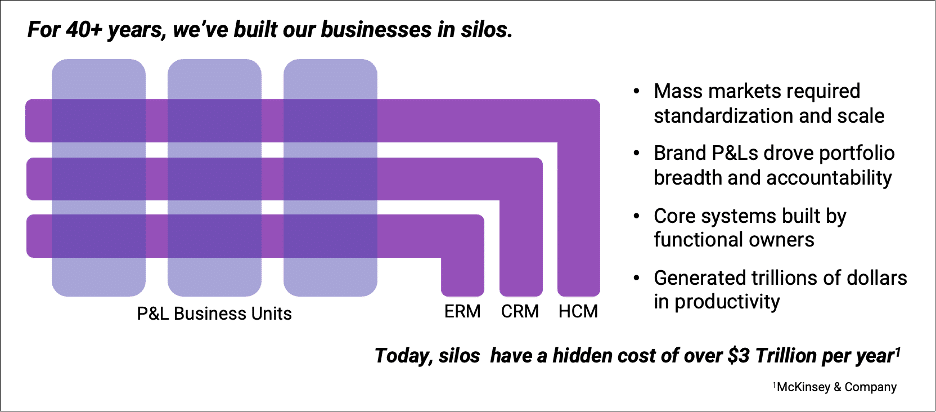
Over time, though, these structures matured to become rigid towers of process and cost. Despite their intention to link business unit silos procedurally, enterprise systems resulted in heightened walls around information, data, and decision-making and became silos unto themselves. Instead of creating efficiencies, these silos now create complexity and have reached the point of diminishing returns.
Jack Welch attempted to attack the problem at GE with his famous “work-out” process and vision of a “boundaryless organization.” In the last decade, HBR has published at least one article a year focusing on the subject. And here’s the ringer: McKinsey now estimates that data silos are contributing $3.1 trillion in lost revenue and productivity.
Over the last two decades, various management paradigms have emerged with the aspiration of bridging silos across various domains. Sales and marketing teams came together around Omnichannel. Operations, manufacturing, and fulfillment organizations huddled around a “Unified Supply Chain.” HR got into the act with “Data-driven Recruiting.” These approaches built new connections for sure, but their impact was limited given their narrow scopes, different data structures, and mismatched market views. Off-the-shelf solutions were limited and focused on workflows or basic analytics, forcing most companies to build their own solutions in an attempt to create cross-enterprise agility (assuming their pockets were deep enough). Internal IT teams and data scientist drove a wave of “AI adoption” with custom-developed solutions, which have now contributed to a 90% failure rate in meeting business expectations (as estimated by Gartner and others).
Anyone working in a large, complex organization has come face-to-face with the trade-offs. While silos create focus and accountability, it is too often at the expense of speed, collaboration, and innovation. As businesses digitized and product/market cycles accelerated, the silos constrained change. When customers expected an integrated experience, silos fought back with conflicting information. And when leadership needed faster decision-making, silos resisted with dispersed, duplicated and often contradictory data. Silos endured, became the insurmountable status quo, and change agendas shifted to other priorities. Today they represent existential threats to innovation and competitiveness.
Now we can have our Silos—and eat them too.
Despite their intransigence, all organizations benefit from the structure created by business silos. Deep specialization, clear accountability, and scale efficiencies are the obvious advantages they create. Our challenge is to address the enormous intrinsic value being lost in and between the silos – insights, knowledge, decision-making speed, and cross-unit innovation – that can contribute immensely to a firm’s competitiveness and shareholder return. Our opportunity is to improve collaboration, innovation, and execution among silos to create a new form of Decision Advantage.
Experienced managers know that industrial processes must endure even though complex structures will continually require process, role, and responsibility refinements. Silos are with us. Our challenge is not to eliminate the silos (with apologies to Jack) but to systematize how we identify, capture, and convert the value that is being lost in the matrices they create.
For example:
- Unifying demand signals versus fostering competing plans.
- Enabling localized merchandising versus generic distribution.
- Aligning talent versus hiding and duplicating human capital.
- Embedding demand-driven agility in supply chains versus greater inertia.
- Streamlining enterprise resource allocations versus constraining them.
- Driving more innovation versus suffocating it.
- Reshaping contributions of business silos versus trying to “bust” them.
New AI. New Possibilities.
This possibility is now at our doorstep. The requirements are built on two areas of focus that we’ll discuss in upcoming articles.
- New technology. Nearly a decade into the era of Enterprise AI, capabilities have advanced to where our traditional assumptions about data models are irrelevant. Nice tidy data partitions created by silos should no longer be barriers. They can become pipelines feeding into new decision-making engines. While generative AI is writing poetry and grabbing headlines, more expansive applications of AI are generating new levels of company performance and societal well-being. This is the New AI. Instead of rewiring information flows in companies, we can liberate them in a new way to drive the business outcomes companies need, without eliminating the way companies are structured (again, apologies to Jack). And the outputs of a decisioning engine can be better inputs to existing workflow systems without having to replace them. The result is a step-change in information, visibility, decision-making, innovations, and resource-allocation agility. This is the next category of enterprise software: Cross Enterprise Management. We call it XEM®.
- New leadership expectations. Technology alone can’t solve the silo problem. In addition to adopting new data unification and decisioning capabilities introduced by AI, organizations must embrace new cross-enterprise collaboration and management skills, starting with leaders and managers. Just as important as new data structures are the shifts required in the human and leadership dimension, including attitudes, behaviors, and culture.
These developments are opening up new possibilities for organizations of all types across all sectors – the benefits of which touch all corners of life. They also underpin our work here at r4. We look forward to sharing more about these game-changing developments in future articles.
To learn about r4’s Cross Enterprise Management solutions, visit https://r4.ai/software/.