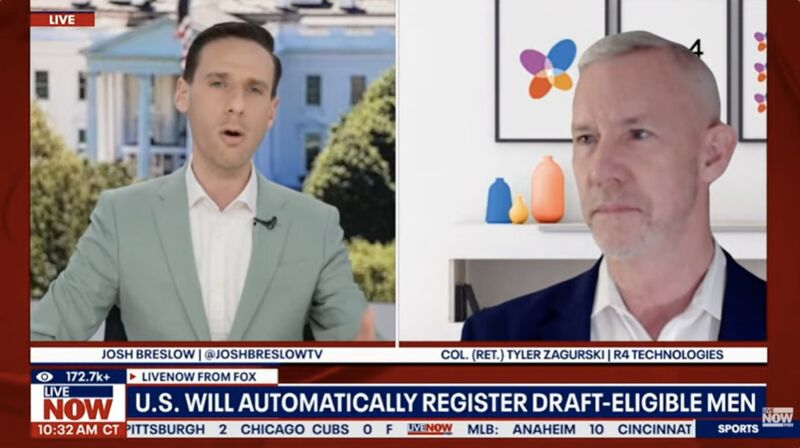
Fox LiveNow – April 11, 2026
Transcript
Host: This week has been news that automatic registration into the US military draft pool for eligible men will start later on this year. The change, which takes effect in December, follows efforts by lawmakers and the Selective Service Agency to streamline the previous self registration process now to help clear up some of the questions and explain what all of that even means and also what it doesn’t mean. I do want to bring in a guest here to help break it down. We do have retired Colonel Tyler Zagurski, who is the vice president of Talent Development at r4 technologies. Thank you so much, Tyler, for taking the time to join us here again. A lot of questions about exactly how all of this works and also really what it means.
Tyler: Yeah, thanks for having me, John, happy to be here, of course. And first off, can you kind of break down, for me, overall, how the current self registration process really works sure and so it’s important to remember this is a system that’s been in place for decades, started under the Carter administration. And forevermore when you turned 18, I turned 18, we marched down to the post office and we registered for the Selective Service. It’s a requirement, and then for the rest of your life, when you’re filling out a federal form or doing something, it’s going to ask you, you know, have you enrolled in the Selective Service? And in some cases, prove it. So that’s that’s been the law of the land since the 70s.
Host: What exactly is this going to do here and and really, what is the significance of it, the importance? What are they hoping to maybe accomplish?
Tyler: Yeah, so it’s a great question, and I encourage people to think of this is really, at its core, a shift in the burden of enrollment, right? Just as I explained for you know, since the enactment of the Selective Service Act, individuals have had to actively enroll. This burden now shifts to the government, whereby the government will use existing data to verify, locate, identify individuals and automatically this act. It’s just that shift in the burden to the government.
Host: And I did want to ask because another question has been, overall, we keep saying draft eligible men, but as far as that goes, Are we talking other groups as well, women, who else would be included there?
Tyler: Well under the current proposed change that comes into effect at the end of the year, we’re still talking about males age 18 to 25 there are some rare exceptions, but by and large, all males 18 to 25 are required to enroll. If you think about, what could this, you know, what would be the next logical extension of this? Of course, there’s been a long debate about women enrolling in the Selective Service. This goes back to the original act. This was, you know, hurting Supreme Court in the 1980s and upheld. But there’s been a lot of change since the 1980s in 2015 the services lifted any restriction on women in combat roles. So I have no inside information about this, but a logical extension, at some point could be a legal or judicial challenge to compel women to enroll in selective service. And of course, it’s important to note here that AI plays a role in just about everything here.
Host: Can you break down for folks out there, what role artificial intelligence is going to play in the whole process streamlining all of this?
Tyler: Sure, and so we’re an artificial intelligence company, and when you think about what the government’s taking on in that burden, they’re going to be querying large data sets, primarily the Social Security Administration, but corroborating with other data sets to verify, enroll, locate, identify a massive amount of people. And while they haven’t publicly disclosed what sort of AI tools they’re using. Using it’s undeniable that this amount of data, these these sort of workflows at this scale, could never be done without the use of AI.
Host: My last question here, and it’s a big one, because it’s the question that just about everyone has been asking for this process to start, does that indicate at any point that a draft is is imminent?
Tyler: Yeah, I don’t see that evidence, right? It’s tempting to sort of conflate world events with this policy and say, Aha, the draft is coming. But I like to think of this in three ways. First of all, this, this legislation was passed in last year by a bipartisan process, and so it predated anything that’s going on in the Middle East. Secondly, something we’ve already talked about, which is that the fundamental elements of selective service haven’t changed with this. And the third thing I was encouraged folks to think about is the fact that we have about less than 1% of our population that serves, and yet we have far and away the most powerful military in the world. So the idea that we need to add hundreds of 1000s or millions of conscripts for us to project power really just doesn’t make sense. So I don’t see that connection that this is some slippery slope to a draft. No, all right.
Host: Retired Colonel Tyler zagurski, thank you so much for taking the time to join us here and helping to break it down. There are so many questions about all of this, so I’m sure we’ll be in touch as we see things get closer and closer to December, when all of this starts to take place. There anything we missed? Anything that you want to make sure to add here about any of this before I let you go.
Tyler: Well, when you talk about AI, I would simply add that AI, you know, if you think about military recruitment and retention, this is already reshaping the way that the services recruit and retain talent. And you think about AI’s ability to ingest sort of massive data sets about people and match them to roles is really powerful their ability to serve, you know, and perform highly, be satisfied in their jobs, and then retain becomes a very virtuous, powerful thing. So AI is already at play amongst the services on how we recruit and retain top talent.
Host: All right, retired Colonel Tyler zagurski At our four technologies. Thank you so much for taking the time to join us. We definitely appreciate it, for sure. Thanks, John, and of course, it’s important to know.