
Case Study
Unhiding Promotional Yield at a Leading Big Box Retailer
How Cross Enterprise Management Transformed Broad Discounting into Precision-Driven Growth

Summary
A Big Box retailer operating in one of the most promotionally intensive segments of retail — spanning team sports, outdoor recreation, footwear, apparel, and private label — had access to immense amounts of data. But it lacked the ability to connect promotional insights across multiple functions. Marketing, Merchandising and Digital operated with partial visibility, producing broad discounts that drove traffic but eroded margin — yield leaking at every silo boundary.
To close these gaps, the retailer deployed r4's Cross-Enterprise Management engine, XEM — connecting customer scoring, product strategy, behavioral signals, and offer design into a single execution environment. Promotional strategy shifted from aggregate discounting to precision-driven growth, delivering measurable lift in response rates, transaction value, retention, and enterprise yield.

Stakeholder Quote: "In one of retail's most promotionally intensive categories, the business constraint was fragmentation: marketing, merchandising, and digital execution were operating without a shared view of customer value — making precision promotion and margin growth harder than it needed to be."
The Silo Problem
Data-Rich. Promotionally Fragmented.
The retailer's promotional engine — circulars, digital campaigns, loyalty communications, and in-store marketing — generated traffic. But the decisions behind those promotions were driven by broad segmentation and category-level discounting rather than coordinated intelligence. High-frequency, high-value customers were routinely exposed to the same offers as infrequent or price-driven shoppers. The result was unnecessary margin erosion: yield given away to customers who would have purchased anyway.
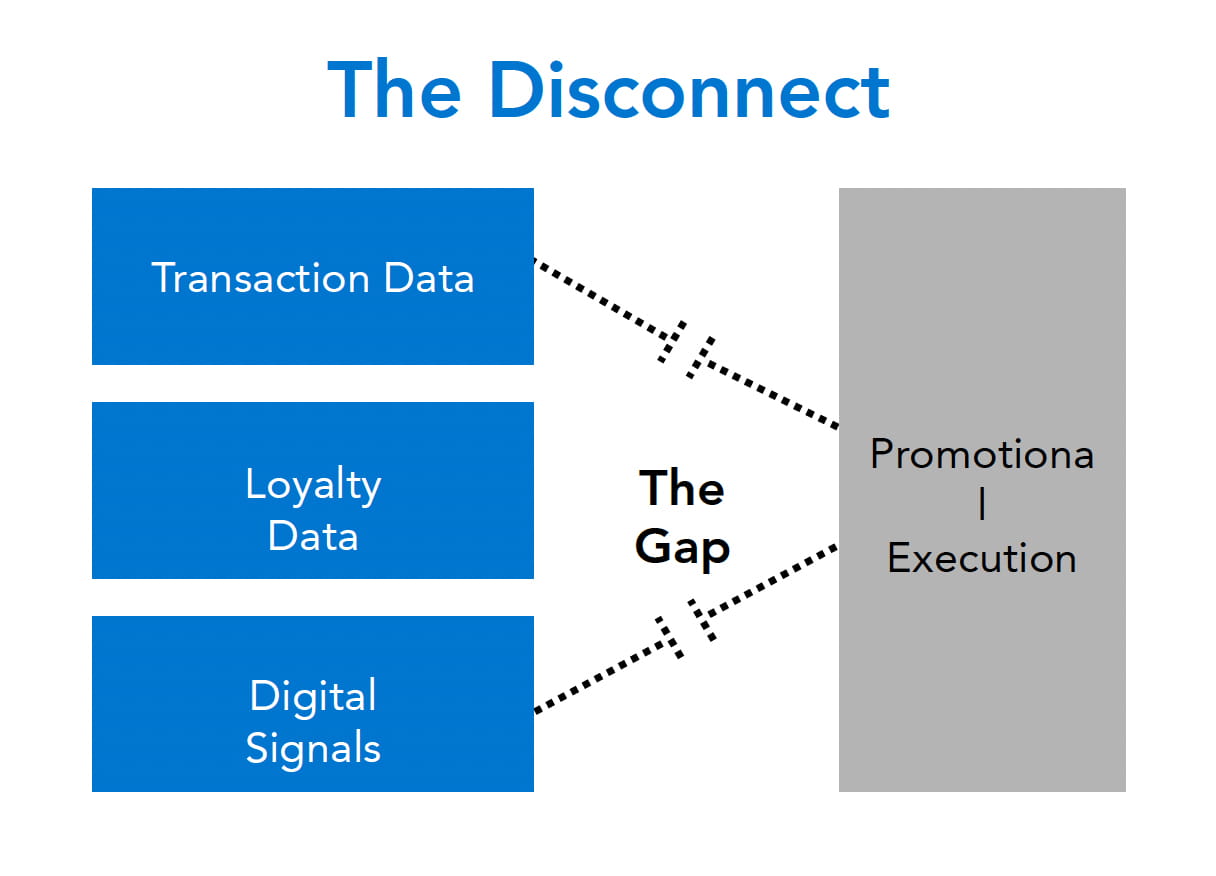
The data required to do better existed across the organization. POS systems captured full transaction histories. Loyalty platforms tracked engagement patterns. E-commerce systems monitored browsing behavior. Merchandising systems maintained assortment and margin data. But each of these environments operated independently — and none of the demand signals they generated were connected to the promotional decisions that needed them.
Without a coordinated intelligence environment spanning these functions, the organization could not precisely answer the commercial questions that drive margin performance.
Which customers are most valuable over time — and how should offers reflect that? Which promotions drive incremental behavior versus subsidize demand that was already there? When is a customer at risk of disengaging — and what coordinated response should follow? How should featured products vary by segment to maximize both response and profitability?
These were not analytical failures. The data existed. The challenge was the absence of Cross Enterprise Management: the gap between where customer intelligence was generated and where promotional decisions got made. Every promotional cycle that ran without connecting those two things was yield leaking between silos.
The Transformation
Cross Enterprise Management in Action
The retailer addressed this challenge by deploying XEM — r4's Cross Enterprise Management Engine — as a unified execution environment connecting customer intelligence directly to promotional planning and action. Rather than treating customer data and promotional execution as separate workflows, XEM connected them into a single coordinated system.
This is Decision Operations (DecisionOps) in practice: predictive AI driving coordinated, real-time action across every enterprise function simultaneously — closing the gap between where customer demand signals are generated and where marketing, merchandising, and digital decisions get made.
What changed operationally
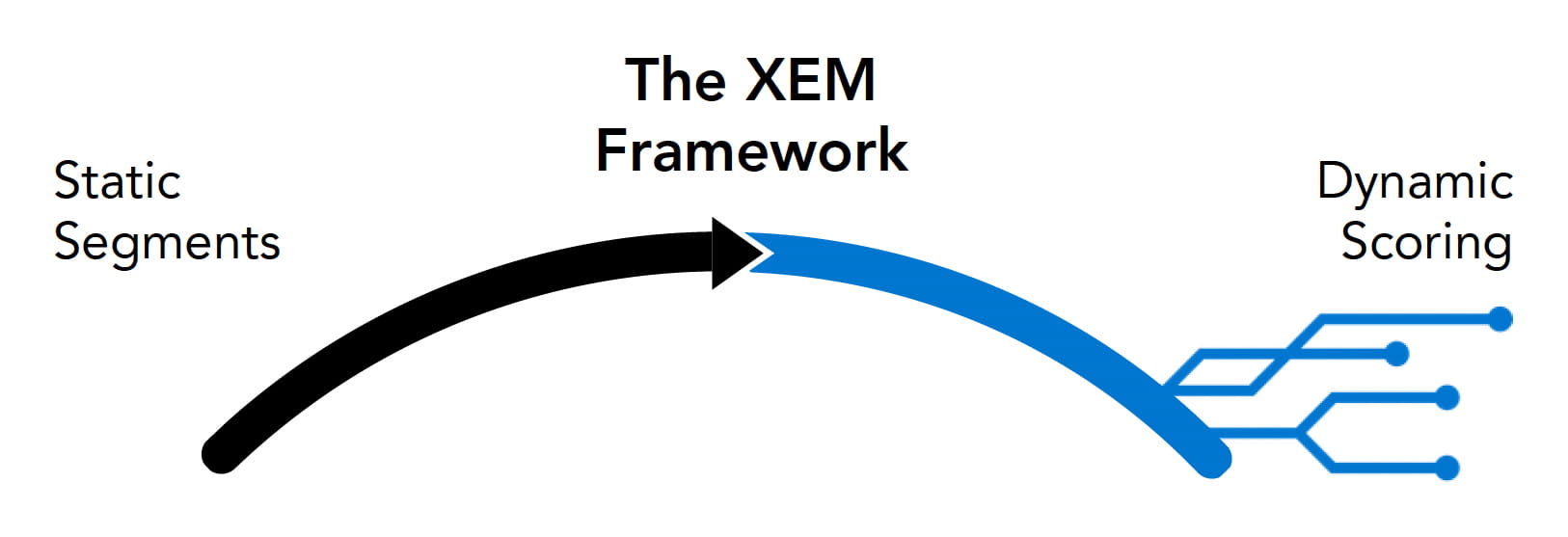
The retailer moved from static demographic segments to dynamic behavioral profiles. Advanced micro-segmentation was built on customer lifetime value, promotion responsiveness, purchase frequency, cross-category affinity, and attrition risk — profiles that updated continuously based on live behavioral signals rather than periodic batch analysis. Static segmentation was replaced by always-on customer intelligence.
Predictive signals were connected directly to campaign design. Featured products were aligned with segment-level demand signals and margin contribution — not category averages. Households purchasing youth sports equipment received curated bundles tailored to seasonal league cycles. Outdoor-focused customers received offers aligned with regional conditions and local activity patterns. Apparel customers were targeted with assortments reflecting purchase frequency, style preferences, and seasonal timing. Promotional execution became as dynamic as the customer behavior driving it.
Price elasticity analysis was applied across all value segments. Predictive models assessed price sensitivity and incremental purchase probability — enabling differentiated offer depth rather than uniform discounting.
High-value customers with low discount sensitivity were engaged with minimal incentives, protecting margin. Price-sensitive segments received targeted promotions structured to drive incremental conversion without broad-based markdown.
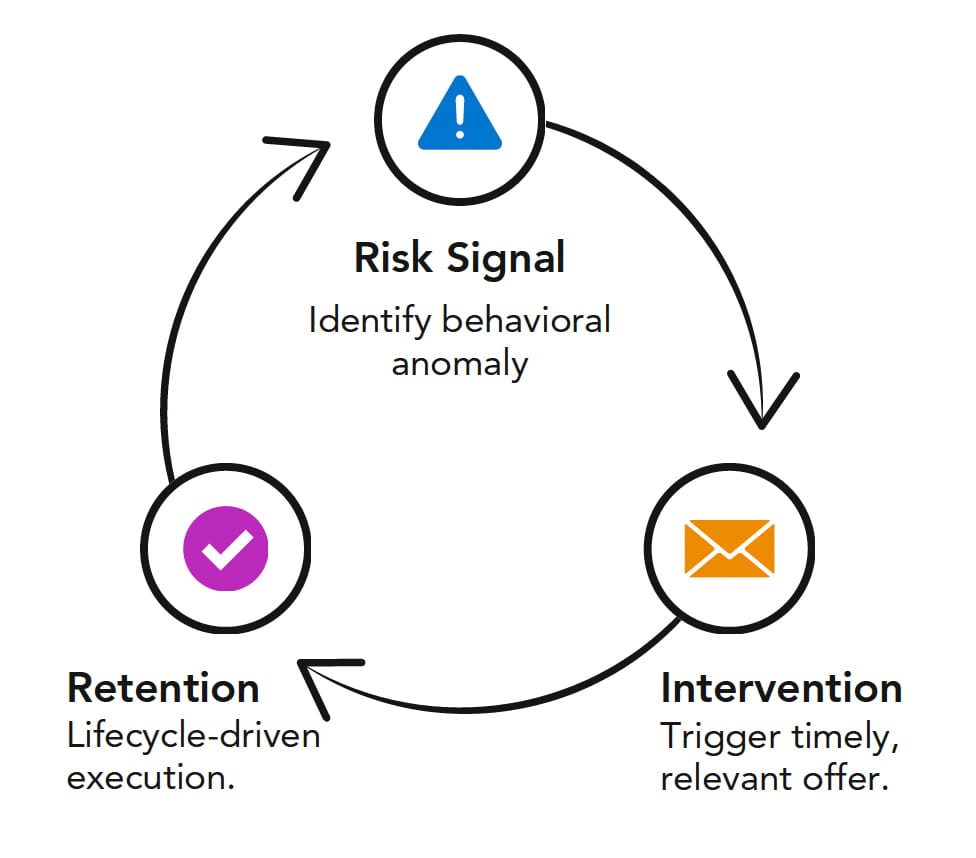
Predictive attrition signals were embedded directly into campaign triggers. Rather than discovering disengagement after the fact, the retailer identified at-risk customers in advance and re-engaged them with timely, relevant offers aligned to individual behavior patterns. The gap between knowing and acting closed — and retention improved as a direct result.
The operational friction separating customer intelligence from promotional execution — the batch-based data cycles, the siloed reporting environments, the manual handoffs between analytics and campaign teams — was removed. That is "decomplexification" at work: the disciplined elimination of the friction between where intelligence is generated and where coordinated action must follow.
Segment A: High Value
- Low discount sensitivity
- Engaged with minimal incentives
Segment B: Price Sensitive
- High discount sensitivity
- Targeted promotions to drive incremental conversion
Business Impact
Enterprise Yield, Quantified
These outcomes were not simply the result of increased promotional activity. They were the result of improved quality of revenue driven by coordinated execution precision across functions that had previously operated in isolation.
Strategic Outcomes
From Broad Discounting to Coordinated Growth
The financial results were the measurable outcome of a more fundamental shift: the organization moved from competing through broader discounting to competing through coordinated execution grounded in predictive customer intelligence.
Old Strategy
Competing through broader discounting and escalating promotional intensity
New Strategy
Competing through coordinated execution and predictive customer intelligence
Conclusion
This retailer's experience illustrates a truth that applies across enterprise retail: the constraint to promotional performance is rarely the absence of data. It is the absence of Cross Enterprise Management — the discipline of connecting customer intelligence across functions, sharing demand signals in real time, and driving coordinated action before yield is given away unnecessarily.
Every silo boundary in this organization was a point where yield leaked.
XEM closed those gaps not by replacing the systems the organization already ran on, but by connecting them into a unified intelligence environment and triggering coordinated action across every function simultaneously. That is Decision Operations. That is Cross Enterprise Management made executable. That is enterprise yield improvement at scale.