
Case Study
Unhiding Revenue at a Leading Global CPG Beverage Company
How Cross Enterprise Management Unlocked $270M in Enterprise Yield Summary

Summary
A leading global CPG beverage company operates a diverse portfolio of hydration brands across grocery, mass, club, and convenience channels, creating one of the most operationally complex — and data rich — environments in consumer goods. Insights to drive profitable growth existed but they were not connected across finance, supply chain, category management, and sales for coordinated action. Each function operated with partial visibility and uncoordinated action. Demand signals never reached supply chain in time to matter, and yield leaked at every silo boundary.
To close those gaps, the company deployed r4's Cross-Enterprise Management engine, XEM, to connect commercial signals, supply chain execution, and category strategy into a single coordinated decision environment. Decisions that once lagged by days or weeks were synchronized across functions, shifting execution from reactive course-correction to precision-driven growth.
The Silo Problem
Data-Rich. Operationally Fragmented.
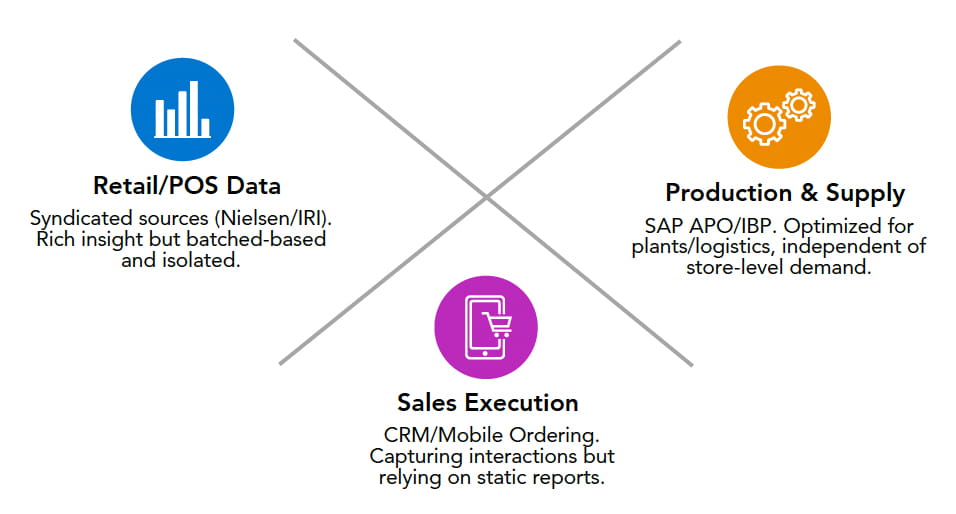
Like most global CPG manufacturers, this company relied on a robust enterprise systems landscape. Financials, order-to-cash processes, pricing, and inventory management were managed across multiple ERP environments. These systems provided accurate historical records of orders, shipments, and margins but they were not designed to deliver store-level predictive signals to field sales teams.
Retail performance data flowed separately through syndicated sources and direct retailer POS feeds. Rich in potential, this data was batch-based and analyzed in isolated environments. It was rarely connected directly into sales workflows where it could drive coordinated action.
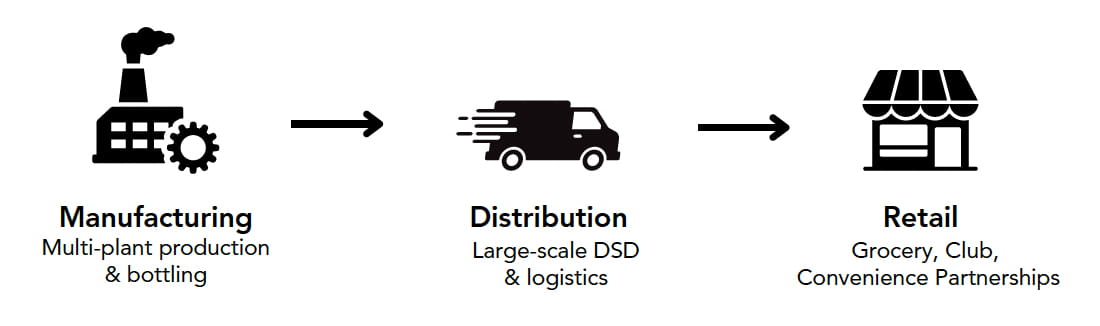
On the operational side, production planning and supply alignment were managed through advanced planning systems optimized for plant scheduling, bottling capacity, and distribution logistics. These tools operated largely independently from store-level demand signals and field execution — disconnected from the commercial functions whose decisions depended on them.
The Enterprise Disconnect: Data-Rich but Operationally Fragmented
"Finance, supply chain, category management, and sales each had partial visibility into performance, but no unified view existed to drive synchronized commercial execution."
Sales representatives, meanwhile, worked from CRM systems and mobile ordering applications that captured account interactions but offered no predictive intelligence. Reps were left to manually reconcile conflicting data sources and prioritize opportunities based on experience rather than coordinated signals from across the enterprise.
Every one of these outcomes was yield leaking between silos. Not because the data didn't exist — but because the functions that held it weren't connected.
The result was a classic silo problem with direct yield consequences.
The Transformation
Cross Enterprise Management in Practice
The company addressed this challenge by deploying XEM — r4's Cross Enterprise Management Engine — as a coordinated intelligence layer above its existing systems. Rather than replacing core enterprise infrastructure, XEM connected ERP, POS, production planning, trade promotion, and field execution environments into a unified decision environment that none of those systems could create independently.
This is Decision Operations (DecisionOps) in practice: predictive AI driving coordinated, real-time action across every enterprise function simultaneously — closing the gap between where demand signals are generated and where operational decisions get made.
What Changed Operationally
Store-level sell-through trends were analyzed continuously alongside margin profiles, inventory positions, order cadence, and peer-store benchmarks. Production capacity and supply constraints were factored directly into commercial recommendations — ensuring that growth initiatives aligned with operational realities rather than running ahead of them.
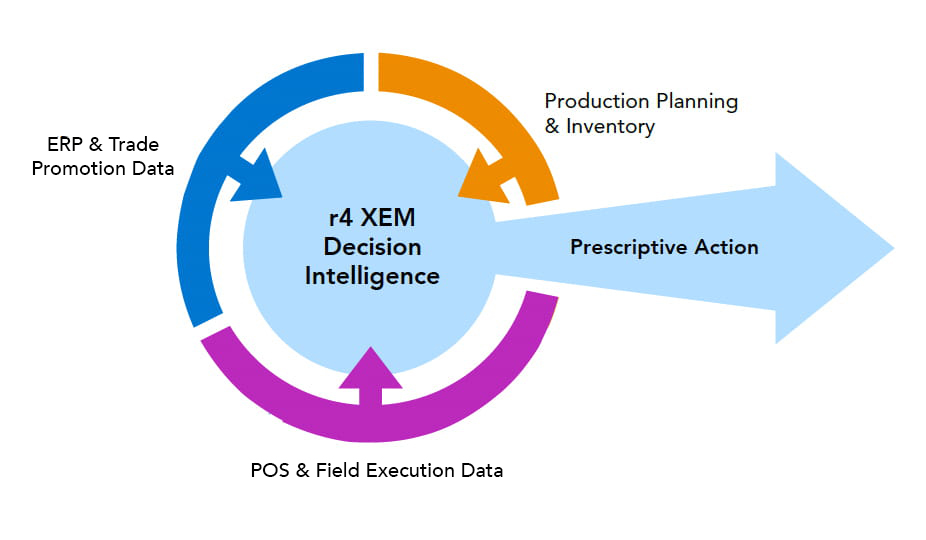
Predictive signals were embedded directly into field sales workflows. Instead of navigating multiple disconnected systems, sales representatives received prioritized, account-specific recommendations supported by quantified revenue and margin impact. Conversations with retail partners shifted from reactive order-taking to strategic growth discussions grounded in financial evidence.
Supply chain planning gained real-time visibility into store-level demand patterns, enabling more responsive replenishment decisions. Finance obtained margin transparency tied directly to field execution — closing the loop between commercial strategy and operational performance.
The operational friction that had separated insight from action — the manual handoffs, the batch-based data cycles, the system boundaries that prevented functions from sharing signals — was removed. That is "decomplexification" at work: the disciplined elimination of the friction between where intelligence is generated and where decisions get made.
Business Impact
Enterprise Yield, Quantified
When commercial and operational data were unified into a single coordinated intelligence environment, the yield that had been hiding between silos became visible and capturable.
Strategic Outcomes
From Reactive to Predictive
The financial results were the measurable outcome of a more fundamental shift: the organization moved from a reactive operating model to a predictive one.
Before XEM, the company discovered missed opportunities after the fact — in last week's report, in a stockout that had already cost a sale, in a distribution gap identified too late to act on. After XEM, the organization could proactively identify high-potential distribution gaps, optimize product placement, and prevent stockouts before revenue was lost. Demand signals reached supply chain functions in time to drive coordinated responses. Field execution was guided by predictive intelligence rather than static reports and institutional knowledge.
Conclusion
This company's experience illustrates a truth that applies across enterprise CPG: the constraint to profitable growth is rarely the absence of data. It is the absence of Cross Enterprise Management — the discipline of connecting functions, sharing intelligence in real time, and driving coordinated action before the cost of inaction compounds.
Every silo boundary in this organization was a point where yield leaked:
- Between the demand signal that commercial teams saw and the supply response that should have followed
- Between the margin opportunity that existed in the data and the field execution that should have captured it
- Between the out-of-stock risk that was predictable and the replenishment action that should have prevented it
XEM closed those gaps — not by replacing the systems the organization already ran on, but by connecting them into a unified intelligence environment and triggering coordinated action across every function simultaneously. That is Decision Operations. That is Cross Enterprise Management made executable. That is enterprise yield improvement at scale.